Ecology
Food webs
Following energy from meadow plants to the animals that eat them.
Many meals, connected
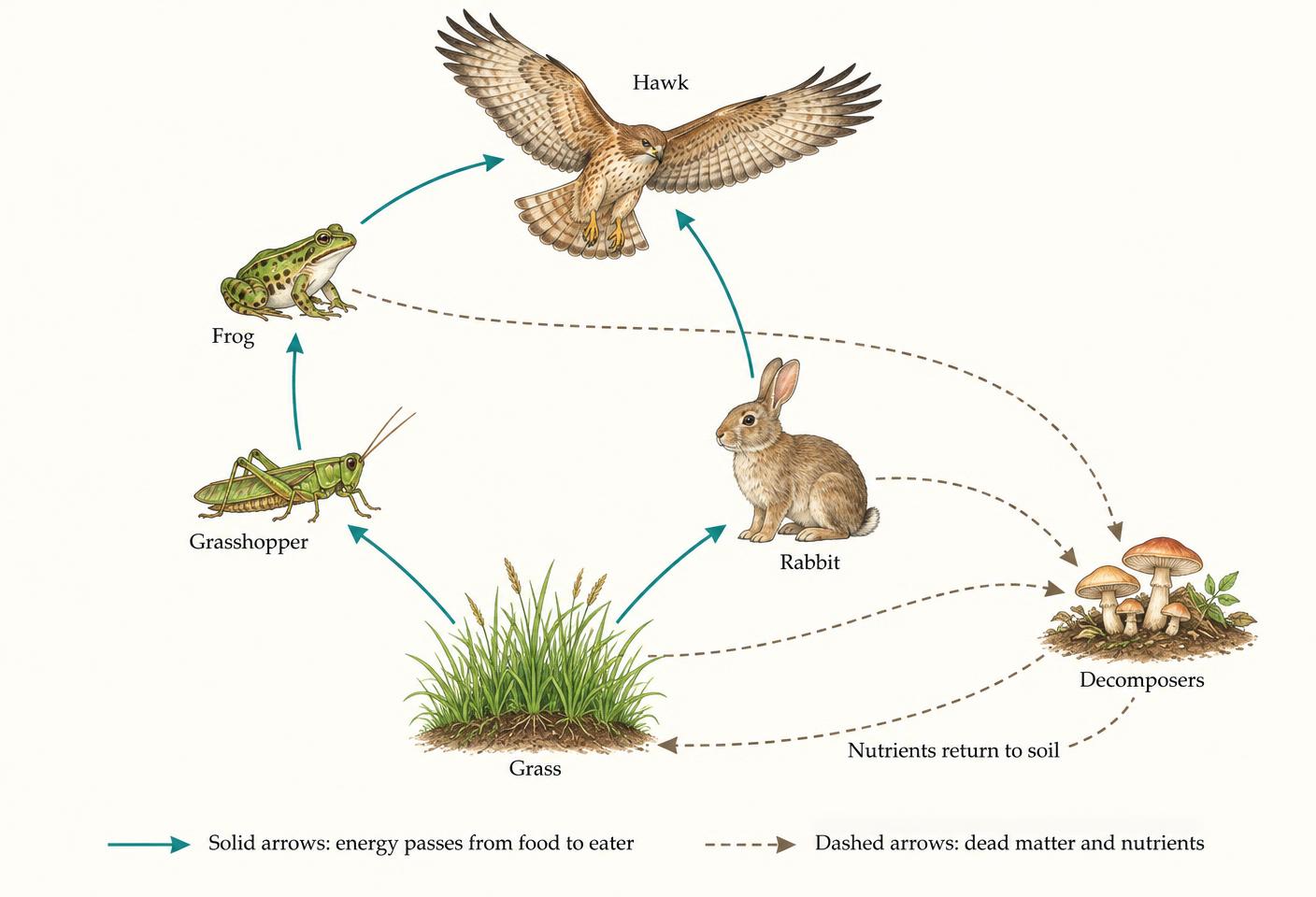
The solid arrows follow energy from food to the organism that eats it. Grass supports grasshoppers and rabbits; frogs eat grasshoppers, and hawks can eat frogs and rabbits. These connected feeding paths form a simplified food web. A real meadow has many more connections, and a predator may depend on several different prey species.
The dashed paths tell a different story: dead material is broken down by decomposers, including fungi and bacteria. Nutrients return to the environment and can be taken up by plants again. Nutrients cycle, but energy does not. Organisms use energy for movement, growth and other activities, and much of it eventually leaves as heat. Only part of the energy at one feeding level becomes available to the next.
The bigger picture
The same cellular processes underpin an entire ecosystem. Plants capture sunlight, food carries chemical energy between organisms, and cellular respiration helps organisms use that energy.
Key terms
- Producer
- An organism that makes organic food, usually using sunlight.
- Consumer
- An organism that obtains food by eating other organisms.
- Decomposer
- An organism that breaks down dead organic material.
- Food web
- A network of feeding relationships in an ecosystem.