Human biology
Gas exchange
The quiet exchange between each breath and your bloodstream.
Where air meets blood
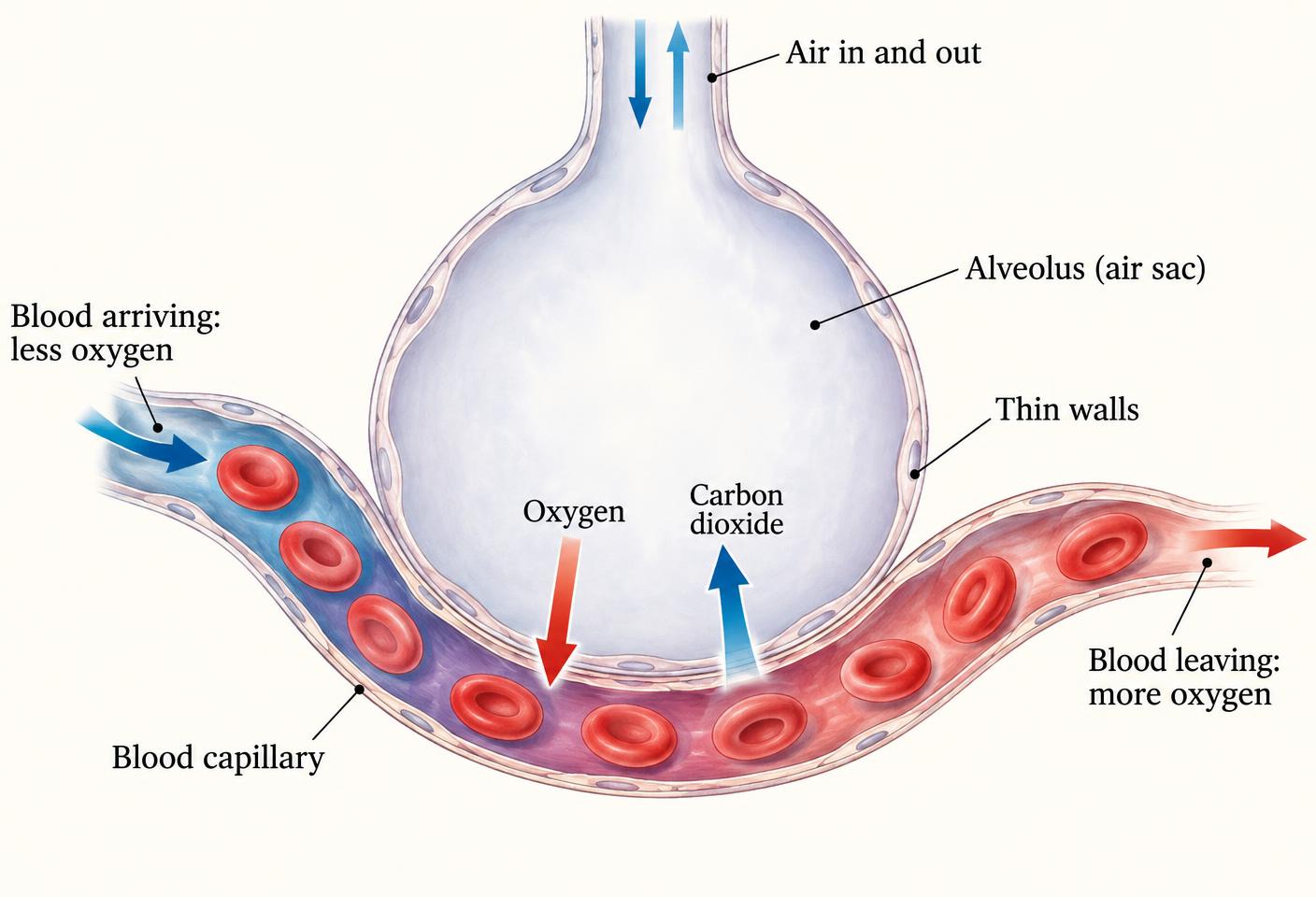
This picture enlarges one alveolus, a tiny air sac in the lungs. A capillary wraps around it, bringing blood close to the inhaled air. Oxygen crosses the thin barrier into the blood, where most of it binds to haemoglobin in red blood cells. Carbon dioxide travels in the opposite direction, into the air sac, ready to leave when you breathe out.
Both gases move by diffusion: each moves down its own partial-pressure gradient, rather than being pumped through the wall. Millions of alveoli provide a large surface area, and their thin, moist walls keep the distance short. Breathing refreshes the air while circulation brings in new blood, helping maintain these gradients. Blue and red in the diagram indicate lower and higher oxygen levels; blood itself is always a shade of red.
The bigger picture
The lungs bring oxygen into the body, but cells use it. Oxygen accepts electrons at the end of the mitochondrial electron transport chain. Carbon dioxide produced during fuel breakdown travels back to the lungs.
Key terms
- Alveolus
- One of the tiny air sacs in the lungs.
- Capillary
- A small blood vessel with a thin wall.
- Diffusion
- Net movement down a concentration or partial-pressure gradient.
- Haemoglobin
- The oxygen-binding protein in red blood cells.