Earth & ecology
The water cycle
Following water through the atmosphere, the land and the living world.
Water on the move
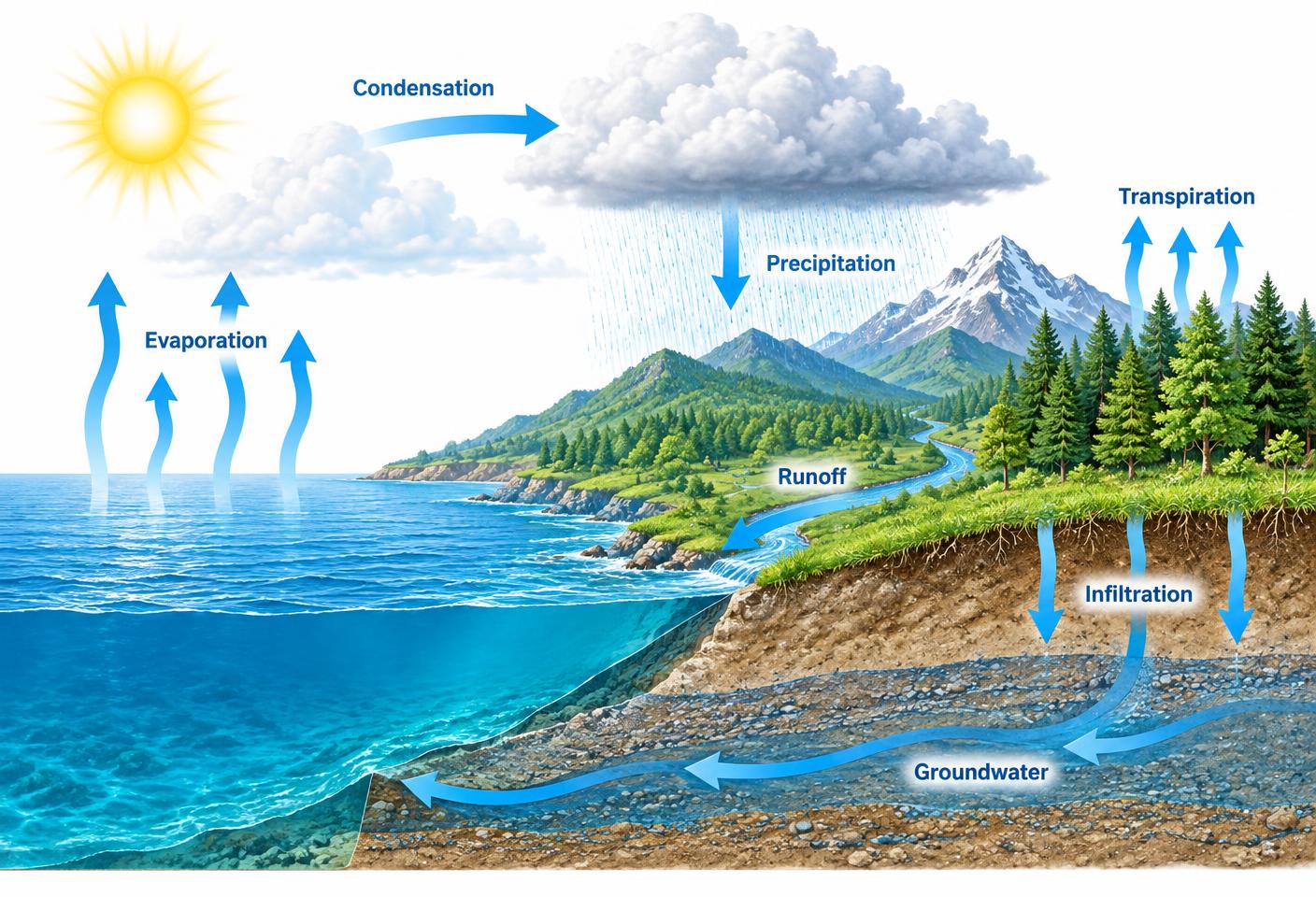
The upward arrows above the sea show evaporation: liquid water becomes water vapour and enters the atmosphere. Energy from the sun helps drive this change. As moist air cools, some of its water vapour condenses into tiny droplets or ice crystals, forming clouds. Water vapour itself is invisible; the cloud in the picture is made of condensed water.
The downward arrow from the cloud shows precipitation. Water returns to the surface as rain, snow or other forms of falling water. Some flows across the ground into streams and rivers, a process called runoff. Some infiltrates the soil and moves deeper through pores and cracks, replenishing groundwater. The underground arrows represent slow movement toward places such as springs, rivers and the sea, not a single open pipe beneath the land.
Trees also connect the land to the atmosphere. Roots take up water, and much of it later leaves the leaves as vapour through transpiration. Water can spend very different lengths of time in clouds, soil, lakes, ice or underground stores. The diagram brings these paths together, but a drop does not have to follow every arrow in a fixed order.
The bigger picture
Water carries dissolved nutrients, supports photosynthesis and provides habitats for living things. Forest cover, soil conditions and human activities can change how much water soaks into the ground or runs off the surface, linking the water cycle to the health of ecosystems.
Key terms
- Evaporation
- The change from liquid water to water vapour.
- Condensation
- The change from water vapour to liquid droplets.
- Transpiration
- The loss of water vapour from plants, mainly through leaves.
- Infiltration
- The movement of water from the surface into the soil.